
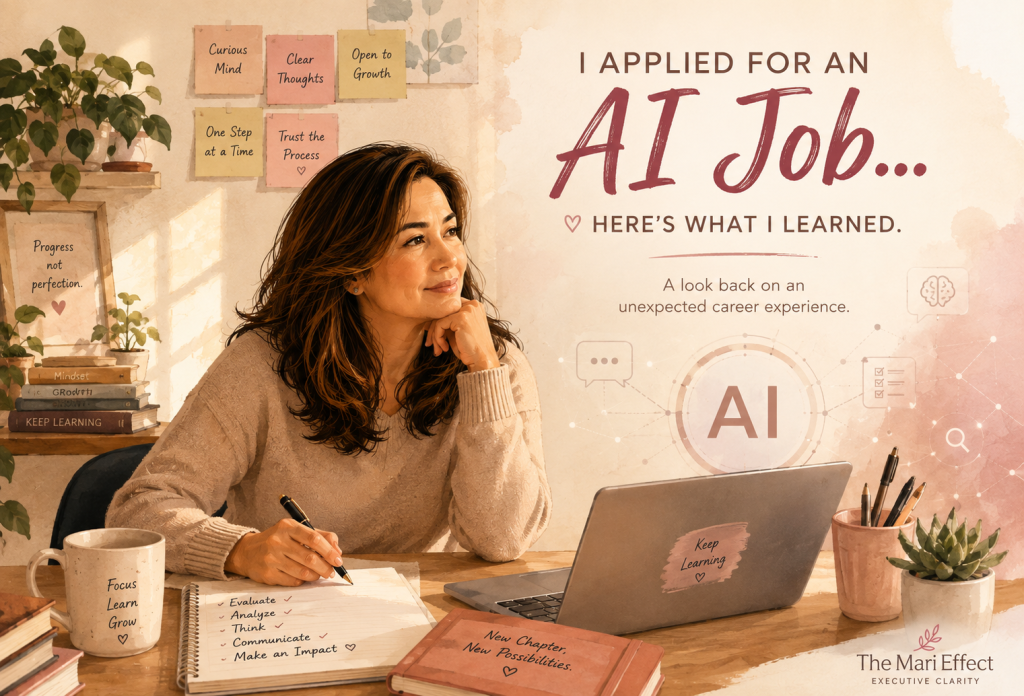
I’ve been meaning to write about this experience for a while.
In fact, it’s probably overdue. 😊
A while back, I stepped into a space that was still relatively new to me: AI.
Not as a developer.
Not as a programmer.
And definitely not as someone who could explain every technical detail behind an AI model.
I was simply curious.
I wanted to understand what happens behind the scenes when people evaluate AI-generated responses, and I wanted to see whether the skills I had built over the years could translate into this new kind of work.
So I applied for an AI Evaluator role.
At the time, I didn’t really know what to expect.
Looking back now, what I remember most isn’t the application itself. It’s how much I prepared for something that turned out to be very different from what I had imagined.
And there’s a lesson in that.
Preparation Mode: Apparently, I Was Defending a Thesis
Before the interview, I prepared like I was about to defend a thesis.
I researched possible interview questions. I practiced structured answers. I reviewed what AI evaluation involved and tried to understand what evaluators were actually expected to look for.
I imagined all sorts of possibilities.
What if they ask me something technical?
What if they give me a complicated AI response to evaluate?
What if I don’t know the answer?
By the time the interview came around, I had mentally prepared myself for a serious technical conversation.
I was ready.
Or at least, I thought I was.
The Assessments Were More Manageable Than I Expected
The application process included several assessments, including evaluation tasks, writing-related activities, and a Versant English assessment.
I’d seen plenty of people talk about how difficult these assessments could be, so naturally, I prepared myself for a challenge.
But interestingly, I didn’t find the process as overwhelming as I had expected.
That doesn’t mean the assessments were easy.
They still required attention, accuracy, and the ability to follow instructions carefully.
But as I went through them, I noticed something.
A lot of what I was being asked to do came down to skills that weren’t necessarily technical.
Clarity.
Structure.
Reasoning.
Understanding instructions.
Being able to communicate an idea clearly.
Those were skills I’d been using for years.
I just hadn’t thought of them as skills that could potentially open a door into AI.
Then Came the Interview
After all that preparation, I finally got to the interview.
And I was expecting…
Well, something much more complicated.
Instead, I was asked to introduce myself and describe a picture.
That was it.
No complicated technical grilling.
No surprise programming questions.
No interrogation about machine learning algorithms.
I remember thinking, Wait… that’s the interview? 😄
Looking back, I can laugh about it now.
But at the time, it was a good reminder of how easily we can create a much bigger version of something in our heads before we’ve actually experienced it.
Sometimes the uncertainty is harder than the thing itself.
What I Realized Afterward
The biggest lesson I took away from the experience wasn’t really about AI.
It was about transferable skills.
When we hear the word AI, it’s easy to assume that everyone working in the field must have a highly technical background.
And yes, there are certainly AI roles that require deep technical knowledge.
But not every role does.
Some AI-related work depends heavily on people who can read carefully, think critically, recognize patterns, follow detailed guidelines, compare information, and communicate their reasoning.
Those abilities don’t suddenly become valuable because AI exists.
We’ve been developing them all along.
We just may not have called them “AI skills.”
Your Experience May Be More Relevant Than You Think
This experience also made me look differently at my own career.
I’ve worked in very different environments over the years.
Broadcasting.
Executive support.
Customer service.
Technology support.
Teaching.
Business.
Digital marketing.
And eventually, AI-related work.
At first glance, those experiences might look disconnected.
But when I look closer, I can see the common threads.
Communication.
Research.
Problem-solving.
Attention to detail.
Adaptability.
Working with people.
Learning new systems.
Making sense of information.
Following through.
Those skills aren’t limited to one industry.
They’re skills you carry with you.
And sometimes, that’s exactly what allows you to step into something new.
If You’re Thinking About Applying for an AI Role
If you’ve been curious about AI-related work but keep telling yourself, “I’m not technical enough,” don’t automatically count yourself out.
Start by understanding the specific role.
What does it actually require?
What kind of assessments are involved?
What skills are being tested?
And perhaps most importantly:
What experience do you already have that might transfer?
You don’t need to know everything before you begin.
You do need to be willing to learn.
And if you’re applying for an evaluation or communication-heavy role, I’d pay particular attention to a few things:
- Practice communicating your thoughts clearly.
- Learn to follow instructions precisely.
- Practice comparing information objectively.
- Get comfortable explaining why you reached a particular conclusion.
- Don’t underestimate your existing professional experience.
And don’t let the word AI intimidate you before you’ve even explored what the job actually involves.
A Small Realization Along the Way
There’s another reason this experience stayed with me.
I’ve spent a lot of time learning new things over the years, sometimes wondering whether I’m spreading myself too thin.
One course leads to another.
One technology leads to another.
One opportunity opens the door to something I had never considered before.
It can be easy to look at that from the outside and wonder where all of it is leading.
I’ve wondered that myself.
But looking back at experiences like this, I see something I didn’t always recognize at the time.
The learning wasn’t necessarily random.
The skills were accumulating.
The pieces were connecting.
The communication skills I developed through teaching can help me in professional conversations.
The attention to detail I developed through executive support can help me work with systems.
The curiosity I developed through technology can lead me toward AI.
And the ability to learn?
That might be one of the most valuable skills of all.
So, Was It Worth Applying?
Absolutely.
Not simply because I wanted the job.
But because applying gave me an opportunity to test an assumption I had about myself.
Could someone with my background actually find a place in this new AI-driven world?
That experience gave me an encouraging answer.
I may not have started out as an AI specialist.
But I realized I didn’t necessarily need to.
I could start with what I already knew, stay curious, learn what I didn’t know, and build from there.
And that’s something I’ve carried with me ever since.
If You’re Standing at the Edge of Something New
If you’re considering applying for a role that feels slightly outside your comfort zone, I hope you don’t dismiss yourself too quickly.
You might not have the perfect background.
You might not check every box.
You might even spend an unreasonable amount of time preparing for an interview that turns out to be much simpler than you imagined. 😄
But you might also discover that you already have more of what you need than you thought.
Sometimes a new career direction doesn’t begin with knowing exactly where you’re going.
Sometimes it begins with being curious enough to knock on a door.
And seeing what happens when it opens.
A Note From Me
I’m sharing this experience now because I think it’s easy to forget how many times we’ve already stepped into unfamiliar territory.
We learn something new.
We try something different.
We wonder whether we’re qualified.
We worry that everyone else knows more than we do.
And then, somewhere along the way, we realize that we weren’t starting from zero after all.
We were bringing years of experience with us.
If you’re navigating your own career transition, exploring AI, learning new skills, or simply trying to figure out where your experience fits in a changing world, I’d love to hear from you.
Feel free to reach out.
I’m always happy to share my journey of learning different skills, exchange ideas, or simply have a conversation.
Sometimes, one conversation is enough to make the next step feel a little clearer. ❤️
About The Mari Effect
The Mari Effect exists to help founder-led businesses replace operational chaos with calm, clarity, and confidence through business systems, executive workflows, strategic websites, and CRM automation.
Because technology isn’t the goal.
Helping people work better is.