The moment I realized digital marketing was teaching me how to see the entire business differently.
For the longest time, I thought digital marketing was mostly about getting people to notice you.
You create the website. You post on social media. You write a blog. You make a pretty graphic. Maybe you throw in a few hashtags for good measure. 😂
And somewhere in the middle of all that, hopefully, someone buys something.
Simple enough, right?
Well, not quite.
The more I study digital marketing, the more I realize that marketing isn’t really about getting someone to buy. It’s about understanding what happens before they buy, why they decide to buy, and what happens after.
That realization has slowly changed the way I look at businesses, including my own.
It Starts Before They Ever Meet You
Think about the last time you bought something you actually cared about.
You probably didn’t wake up one morning and decide, completely out of nowhere, that today was the day you were going to purchase a particular product or service.
There was usually something behind it.
Maybe you had a problem that had been bothering you for a while. Maybe you wanted something you didn’t have. Maybe something stopped working. Perhaps someone recommended a solution, or you happened to see something while scrolling.
Maybe you searched Google.
Maybe you asked an AI tool.
Or maybe you saw the same business a few times before finally thinking, Okay… fine. I’ll click. 😂
That is part of the customer journey.
And it starts long before the transaction.
It starts with a person who has a need, a question, a frustration, a goal, or sometimes just a little curiosity.
That’s where marketing begins.
The Journey Is Bigger Than the Purchase
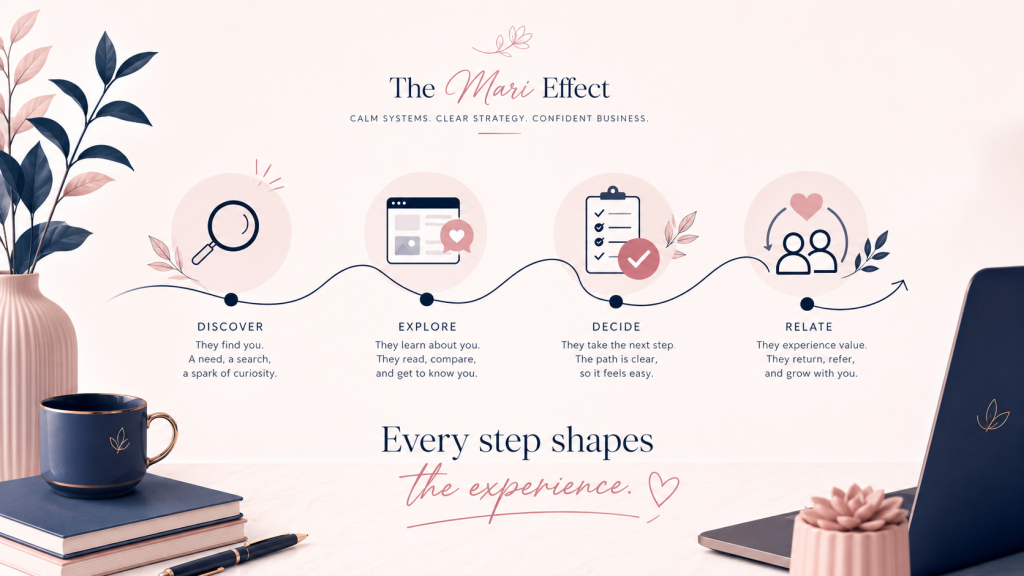
One of the frameworks I’m currently learning looks at the customer journey through four stages:
Awareness → Engagement → Conversion → Retention
The framework itself isn’t particularly complicated. What interested me was what happened when I started thinking about what each stage actually requires from a business.
Awareness
Someone discovers you.
They might find you through Google, social media, a referral, an advertisement, a blog post, or a recommendation from someone they trust.
At this point, they may not be ready to buy. They might not even fully understand what they need yet.
So the job isn’t necessarily to sell.
It’s to become relevant enough to be remembered.
That might happen because you answered a question they had, shared something useful, explained a problem clearly, or simply showed up consistently in a place where they were already looking.
Engagement
Now they’re curious enough to look a little closer.
They visit your website. They read something you’ve written. They look at your portfolio. They compare options. They check reviews. Maybe they follow you for a while before ever contacting you.
Underneath all of that is a very human question:
“Could this actually be the solution I’m looking for?”
This is where content, websites, case studies, reviews, portfolios, and thought leadership become much more than things we create because we’re told we “need content.”
They’re part of the customer’s research process.
They’re trust-building touchpoints.
Someone is trying to understand whether you can help them, whether you understand their problem, and whether they can feel reasonably confident putting their time, money, or business in your hands.
Conversion
Eventually, something changes.
The person decides they’re ready to do something about the problem.
Now the business has another responsibility: make the next step clear.
Can they understand the offer? Can they figure out how to contact you? Can they book a call without searching around for the right button? Do they know what happens after they submit the form? Is the process easy to understand?
I’ve started paying much more attention to these details because they seem small until you look at them from the customer’s side.
Someone can genuinely believe you’re the right person to help them and still walk away if taking the next step feels confusing or unnecessarily difficult.
At that point, the problem isn’t simply that the marketing didn’t work.
Something in the business experience isn’t working either.
Retention
Then comes the part that I think businesses sometimes overlook.
The purchase isn’t the end of the journey. It’s the beginning of the relationship.
What happens after the sale?
Do you communicate well? Do you follow through? Do you make the customer feel looked after? Do you actually solve the problem you promised to solve?
And perhaps the bigger question is whether the experience gives them a reason to come back.
Or to tell someone else about you.
That’s where retention, loyalty, referrals, and reputation begin.
And suddenly, we’re no longer talking about a social media strategy.
We’re talking about the business itself.
Then I Had a Funny Realization
Once I understood the framework a little better, I started looking at The Mari Effect through the same lens.
And, of course, once you start seeing something this way, it becomes difficult to unsee it. 😂
I wasn’t just asking myself, “What should I post on LinkedIn?”
I started asking where my ideal client would actually go when they realized they had a problem they needed help solving.
I wasn’t only thinking about which services I should offer. I was thinking about what my client might be experiencing before they ever reach the point of looking for someone like me.
Even the question of getting someone to book a discovery call started to feel different.
Instead of asking, “How do I get someone to book?” I found myself asking what that person would need to see, understand, and feel before they were comfortable taking that step.
And once someone becomes a client, the questions continue.
What kind of onboarding experience would make them feel confident that they made the right decision? How easy is it to communicate with me? Are expectations clear? Does the way I work make their life easier, or am I simply adding another layer of things they have to manage?
Those are not questions I would have naturally grouped under “marketing” before.
Now I do.
Suddenly, Marketing Became a Business Conversation
This is probably the biggest lesson I’m taking away from studying digital marketing.
The customer journey doesn’t live inside a marketing department.
Especially in a small or founder-led business, there may not even be a separate marketing department. One person might be handling the website, content, sales conversations, client onboarding, delivery, follow-up, and everything in between.
That means the customer experience is shaped by the whole business.
Marketing influences awareness. Sales influences conversion. Operations affects how the promise gets delivered. Customer experience influences whether people stay. And the quality of the overall experience can influence referrals, reputation, and future growth.
All of these things are connected.
Which is why I’ve come to believe that the customer journey isn’t just a marketing problem.
It’s a business problem.
And that matters even more for small businesses because every touchpoint carries a little more weight when you don’t have a huge team behind you.
Even a Small Business Has a Customer Journey
You don’t need a giant corporation with a twenty-person marketing department to have one.
A freelancer has a customer journey.
A consultant has one.
A real estate agent has one.
A travel agency has one.
A restaurant has one.
A virtual assistant has one.
A coach has one.
A local mechanic has one.
Even an ESL teacher has one.
Someone discovers you. They become curious. They evaluate you. They decide whether to work with you. They experience your service. Then they decide whether they want to come back or recommend you to someone else.
The businesses may look completely different from one another, but the human process underneath them is surprisingly similar.
Once I started looking at it that way, customer journey mapping stopped feeling like something that belonged exclusively to large marketing teams.
It became something I could use to look at almost any business.
Including my own.
And Then It Got Personal
Maybe that’s why this framework has been so interesting to me.
I’ve spent years working around communication, people, businesses, and operations. I’ve supported executives, worked in broadcasting, dealt with customers, built businesses, worked with digital tools, created websites, experimented with marketing, and learned different systems along the way.
For a long time, those experiences could feel like separate pieces.
Studying digital marketing has given me a framework for connecting some of them.
It has also given names to things I had sometimes done intuitively.
And that has been surprisingly satisfying.
It’s like looking back at something you did years ago and suddenly understanding why it worked.
“Ohhh. So THAT’S why that worked.” 😂
Sometimes learning something new doesn’t completely change what you already know.
Sometimes it simply gives you a better way to understand it.
I’m Learning to Look Backward to Move Forward
I originally started studying digital marketing because I wanted to understand how to market my business better.
That was certainly part of it.
But I didn’t expect the learning to change how I look at the business itself.
I see the website differently now. It’s not simply a place where information about my services lives. For someone discovering The Mari Effect, it can be one of the first places where they begin deciding whether I understand their world.
I see the blog differently, too. An article isn’t just another piece of content to publish because the calendar says it’s Tuesday. It might be part of someone’s research process. It might answer the question that brought them to the site in the first place.
A social media post can be the first introduction.
A portfolio can provide evidence.
A case study can help someone imagine what working together might look like.
A discovery call can build confidence before any contract is signed.
And the work that happens after someone becomes a client matters just as much.
Because the experience people have with your business becomes part of what they remember about your brand.
That’s why I’ve started thinking of the customer journey less as a marketing funnel and more as a connected experience.
Maybe That’s What Good Marketing Really Is
The more I learn, the less interested I am in the idea that good marketing simply means shouting louder, posting more, or trying to convince everyone to buy.
Good marketing, at least the way I’m beginning to understand it, is much more human than that.
It’s about understanding people well enough to meet them where they are.
Sometimes they need information.
Sometimes they need reassurance.
Sometimes they need proof.
Sometimes they aren’t ready yet, and that’s okay.
Sometimes the most useful thing you can do is simply make the next step easier.
And once they do become a customer, the job isn’t over. You still have an opportunity to show them that the trust they placed in you was well deserved.
That way of looking at marketing feels much more natural to me.
Because the more I study digital marketing, the more I realize that it isn’t really teaching me how to sell.
It’s teaching me how to understand.
And maybe that’s where good business starts.
A Mari Effect Takeaway
If there’s one idea I’m carrying forward from this lesson, it’s this:
Don’t design the customer journey around what you want your customer to do. Design it around what your customer needs at each stage.
That small shift can change the questions you ask.
Instead of asking, “How do I get them to book?” you can ask, “What do they need to understand before they’re ready to book?”
Instead of asking, “What should I post?” you can ask, “What might someone who needs my help be trying to figure out right now?”
And instead of thinking about the sale as the finish line, you can start looking at everything that surrounds it: the communication, the process, the delivery, the follow-up, and the experience.
That’s where marketing starts becoming strategy.
Not because you have more tactics.
Because you have a better understanding of the person moving through them.
Frequently Asked Questions
What is a customer journey?
A customer journey is the series of experiences and interactions a person has with a business, from first discovering it through evaluating the offer, becoming a customer, and deciding whether to return or recommend the business.
What are the four stages of the customer journey?
A commonly used framework describes four stages: awareness, engagement, conversion, and retention. These stages help businesses understand what customers may need as they move from discovering a business to developing an ongoing relationship with it.
Why is the customer journey important for small businesses?
The customer journey matters because every interaction can influence whether someone trusts the business, takes the next step, becomes a customer, returns, or recommends the business to someone else. For small businesses, where resources and touchpoints may be limited, a clear and thoughtful customer experience can make a significant difference.
Is the customer journey only a marketing responsibility?
No. Marketing may influence awareness and engagement, but sales, operations, customer service, delivery, onboarding, and follow-up all shape the overall customer experience. That’s why the customer journey is ultimately a business-wide concern.
What is customer journey mapping?
Customer journey mapping is the process of documenting the different stages, interactions, questions, expectations, and potential points of friction a customer experiences when interacting with a business. It can help identify opportunities to make the experience clearer, easier, and more consistent.
About The Mari Effect
The Mari Effect exists to help founder-led businesses replace operational chaos with calm, clarity, and confidence through business systems, executive workflows, strategic websites, and CRM automation.
My work sits at the intersection of people, processes, technology, and communication.
Because I’ve spent years working across different roles and environments, I’ve learned that the tools themselves are rarely the whole answer. A website, CRM, automation, workflow, or AI tool only becomes useful when it helps people work better.
That’s the perspective I bring to The Mari Effect.
Technology isn’t the goal.
Helping people work better is.
A Gentle Invitation
If you’re building a business and you’ve never really looked at the journey from your customer’s perspective, maybe this is a good time to do it.
Pick one recent customer or client and walk through their experience from beginning to end.
How did they find you?
What did they see first?
What questions were they trying to answer?
Where might they have hesitated?
What made them decide to move forward?
And once they became a customer, what happened next?
You might be surprised by what you discover.
You don’t need to rebuild your entire business overnight. Sometimes the most useful improvements begin with simply noticing where the experience feels harder than it needs to be.
And if you’d like to explore that thinking further, you’re always welcome to stay awhile here at The Mari Effect.
There’s plenty more to unpack when we’re looking at business through the lens of calm operations, clear systems, and confident visibility.
Because sometimes, understanding the journey is the first step toward improving it.