What missing a badge taught me about teaching, growth, and the kind of impact I hope to leave behind.
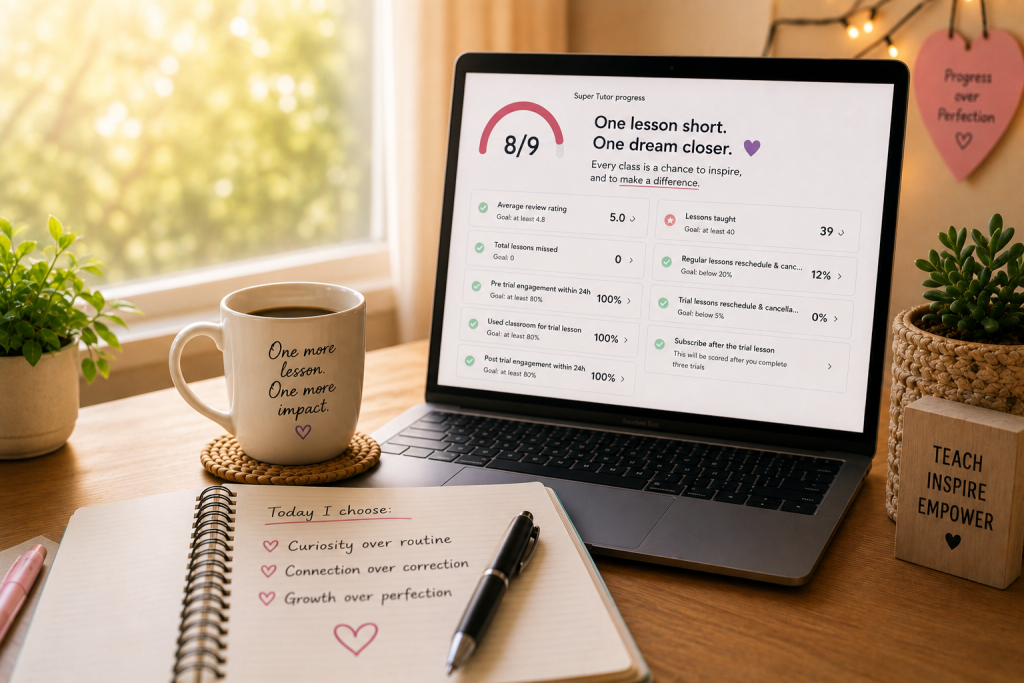
When I opened my Preply dashboard, I saw something almost amusing.
8 out of 9.
One requirement hadn’t been met.
I had taught 39 lessons.
The goal was 40.
One lesson.
Just one.
For a brief moment, I wondered if my class with Jaime later that week might still count. Maybe I could make it after all.
It wouldn’t.
The evaluation period had already closed.
And strangely enough, I wasn’t disappointed for very long.
Because when I looked at the rest of the dashboard, I saw something else.
A 5.0 lesson rating.
No missed lessons.
100% pre-trial engagement.
100% post-trial engagement.
Excellent preparation and clarity scores.
Almost every box was green.
Only one number had kept me from the badge.
And somehow, that one missing lesson became a reminder that numbers can tell a story—but they don’t always tell the whole story.
One Lesson Short
For a moment, I thought about the irony of it.
I was one lesson short of a goal that was supposed to represent consistency and quality.
But the funny thing about teaching is that the most meaningful parts of the job don’t always fit neatly into a dashboard.
A student finally speaks without translating first.
Someone uses an expression they had been afraid to try.
A conversation that once lasted five minutes suddenly lasts thirty.
A learner tells you, “I feel more confident now.”
Those moments don’t always come with a checkmark.
But they matter.
Perhaps even more than the checkmarks.
When the Numbers Become a Mirror
Then I remembered something one of my students wrote about our lessons.
“She is really enthusiastic, and always trying her best to improve the class quality. I can feel that every class is getting better and becoming more tailored to me.”
Of course, seeing five stars made me smile.
But when I read those words again, something else stood out.
My student didn’t mention my grammar explanations.
He didn’t talk about my slides or teaching techniques.
He noticed something much simpler:
Every class was getting better.
He noticed the effort behind the scenes.
The little adjustments.
The conversations after each lesson about what worked and what didn’t.
The decision to reshape activities around his interests instead of repeating the same lesson format.
The willingness to keep experimenting.
That was the compliment that stayed with me.
Not because it told me I was already a great teacher.
But because it reminded me that my students can actually see my commitment to becoming one.
I Don’t Want to Just Fill an Hour
A few months ago, I was asking a very different question:
“How do I teach this lesson well?”
Today, I find myself asking:
“How do I create a lesson my student will remember?”
That small shift has changed the way I teach.
I no longer want to spend sixty minutes simply filling time with questions.
I want the hour to have a purpose.
Sometimes that means turning a topic into a story.
Sometimes it means discussing philosophy, science, technology, or culture.
Sometimes it means helping an advanced learner discover a more natural expression.
And sometimes it means doing something much simpler:
Creating a space where someone feels safe enough to speak.
I have come to believe that students don’t remember every question we ask them.
They remember how a lesson made them feel.
They remember the conversation that made them laugh.
The idea that made them curious.
The moment when something suddenly clicked.
The teacher who listened.
The lesson that felt like it was made specifically for them.
Students don’t remember questions. They remember experiences.
That thought has gradually become one of the foundations of the way I teach.
Teaching Is a Craft, Not a Finished Product
Perhaps that’s what teaching really is.
Not arriving with all the answers.
Not delivering the perfect lesson every single time.
Not having the most beautiful slides or the most impressive teaching credentials.
It is caring enough to make the next lesson a little better than the last.
My student’s review reminded me of that.
“Every class is getting better.”
What a beautiful thing for a teacher to hear.
Because teaching isn’t a finished product.
It is a craft.
And like any craft, it changes as we practice it.
We observe.
We reflect.
We adjust.
We try again.
And hopefully, our students can feel that journey with us.
Beyond the Badge
The more I thought about my almost-Super-Tutor moment, the more I realized that I had been looking at the wrong finish line.
Badges are wonderful.
Ratings matter.
Numbers are useful.
They give us something to measure and something to work toward.
But they cannot measure everything.
They cannot measure the student who finally believes they can speak English.
They cannot measure the trust built over months of conversation.
They cannot measure the courage it takes for a shy learner to speak through a mistake instead of remaining silent.
And they certainly cannot measure the teacher I am becoming.
So yes, I would love to earn that missing point next time.
I’d love to see that 9/9.
But I don’t want the badge to become the reason I teach.
I want it to be a pleasant reflection of the work—not the purpose behind it.
The Teacher I Hope to Become
Somewhere along this journey, my questions began changing.
I started by asking how to prepare individual lessons.
Then I began thinking about curriculum design.
Then learning experiences.
Then teaching philosophy.
Then writing about what I was discovering.
And eventually, another question began quietly growing in my mind:
What if I could inspire other teachers to do things differently too?
Not hundreds.
Not thousands.
Even one or two would make me happy.
I would love to know that another teacher read something I wrote and thought:
“Maybe I could try this with my students.”
Maybe they turn a routine speaking activity into a story.
Maybe they stop worrying about covering every question on a worksheet.
Maybe they give their students more room to be curious.
Maybe they realize that personalization doesn’t require an elaborate system.
Maybe they simply walk into their next class with the intention of making it a little more meaningful.
If something I share can create even that small shift, then perhaps my work can travel farther than my own classroom.
Perhaps Impact Works Like This
I used to think my impact would be measured by the number of students I taught.
Now I wonder if it might also be measured by the teachers I quietly encourage.
If one teacher tries a more thoughtful lesson because of something I shared…
If another discovers that English can be taught through stories instead of scripts…
If a teacher chooses curiosity over routine…
If a student somewhere smiles because their teacher decided to make a lesson feel a little more personal…
Then perhaps that’s how change begins.
Not all at once.
Not through grand gestures.
But quietly.
One lesson.
One teacher.
One student at a time.
A Note to My Future Self
When I read this again months or years from now, I hope I’ve earned many badges.
I hope my classes are full.
I hope my website is alive with stories.
I hope my students still smile when they see my name on their schedule.
And I hope I’ve continued becoming a better teacher.
But most of all, I hope I haven’t forgotten why I started.
I didn’t begin this journey simply to collect titles or numbers.
I wanted to create experiences worth remembering.
I wanted my students to leave a lesson feeling a little more confident than when they arrived.
I wanted to make learning feel less like a task and more like an adventure.
And perhaps, somewhere along the way, I want to remind other teachers that they can do the same.
If one or two educators find a little courage to teach differently because of something I shared, I’ll consider that one of the greatest achievements of all.
Maybe being one lesson short wasn’t really a setback.
Maybe it was a reminder.
A reminder that the number I was missing wasn’t the number that mattered most.
The real measure was already there—in the students who kept coming back, in the conversations that grew deeper, in the confidence that slowly replaced hesitation, and in the simple words of a learner who noticed that every class was becoming more tailored to him.
One lesson short.
One dream closer.
And perhaps that’s enough for today.
Tomorrow, I’ll teach another lesson.
And I’ll try to make it a little better than the last one.
About My ESL Journey
Teaching English has become more than simply helping students improve their language skills.
It has become a space where I get to learn, experiment, listen, and grow alongside the people I teach.
Through online teaching, I’ve discovered that a good lesson isn’t only about getting through the material. It’s about creating a space where someone feels comfortable enough to speak, curious enough to ask questions, and confident enough to keep trying.
Because teaching isn’t just about language.
It’s about helping people find their voice.
Have You Ever Had a Lesson That Stayed With You?
I’d love to hear your story.
Maybe you’re a teacher who remembers a student who surprised you.
Maybe you’re a learner who still remembers a teacher who made English feel different.
Or perhaps you’re somewhere in between—still figuring out what kind of teacher or learner you want to become.
Sometimes the most meaningful lessons aren’t the ones we plan perfectly.
We discover them while we’re living them.
And we carry them with us.
If something in this story resonated with you, I’d love to hear about it.